
How it works
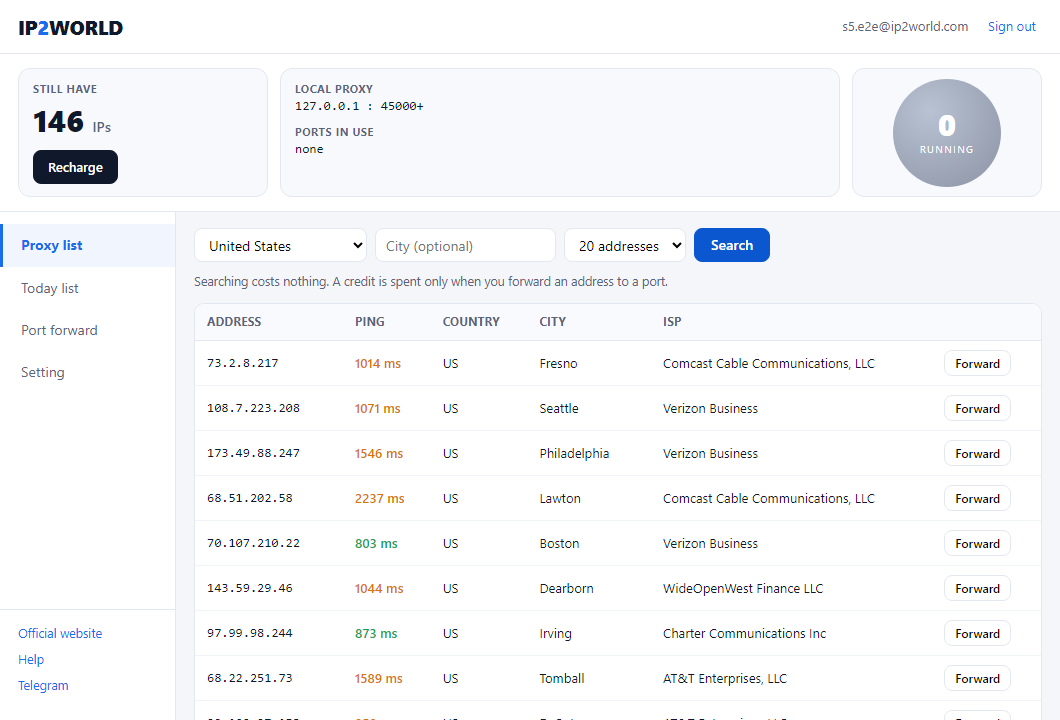
- Search. Choose a country, optionally a city, and how many addresses to look at. The client opens real sessions and asks each one which address it came out of, so what you see in the list is where the traffic actually leaves — not a guess from a database. Searching costs nothing.
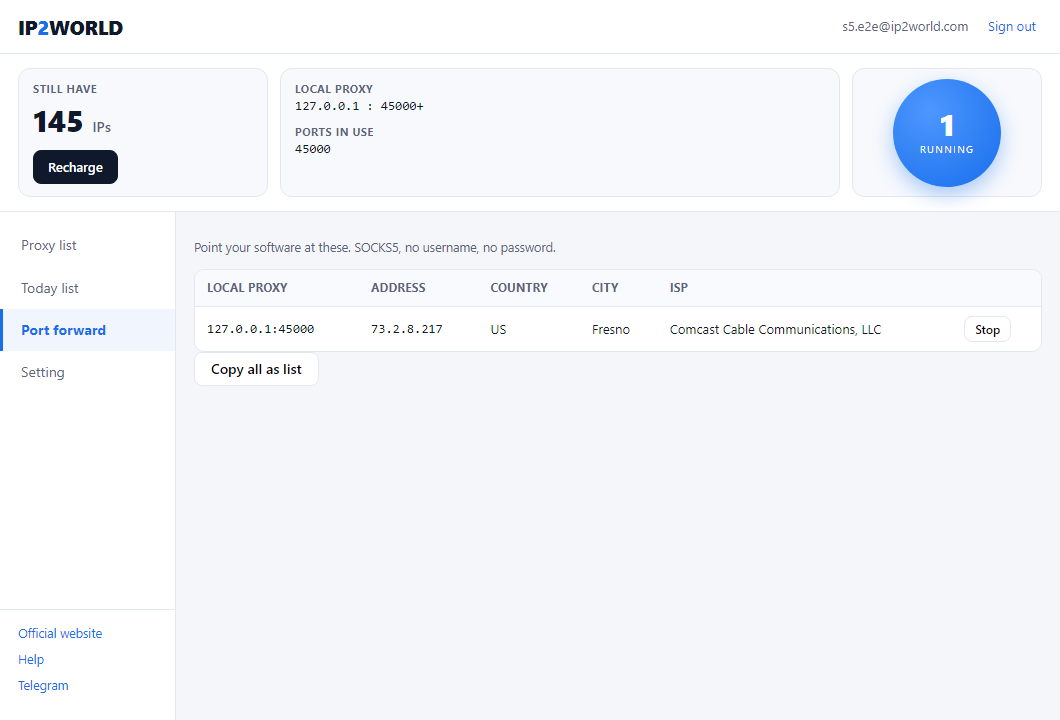
- Forward. Right-click an address and choose a free port from 45000 upwards. One address from your pack is spent at that moment, and only then.
- Use it. Point any program at 127.0.0.1:45000 as a SOCKS5 proxy, with no username and no password. Browsers, antidetect profiles, phones on the same network — anything that speaks SOCKS5.
What the client looks like
Addresses left in your pack at the top left, the local proxy in the middle, ports currently running at the right. The sidebar is the one from the old client: proxy list, today’s list, port forward, settings.
Once an address is on a port it appears here, and this is the whole configuration your software needs.
Packs and prices
Priced per address, the way this product has always been sold. Each address carries 100 MB of traffic, which is comfortable for account work — heavy scraping belongs on the per-gigabyte plans instead.
| Pack | Addresses | Traffic | Price | Per address |
|---|---|---|---|---|
| S5 Starter | 50 addresses | 5 GB | $9.00 | $0.180 each |
| S5 Standard | 150 addresses | 15 GB | $24.00 | $0.160 each |
| S5 Pro | 500 addresses | 50 GB | $69.00 | $0.138 each |
| S5 Scale | 1000 addresses | 100 GB | $129.00 | $0.129 each |
Prices are set and will not move when the product opens. What is not yet fixed is the opening date, which is why there is no buy button on this page — we would rather announce it late than sell it early.
What we can and cannot promise
Everything below is from our own measurements of the pool this product runs on, taken in September 2026, rather than from a supplier’s brochure.
- Country and city. You choose both, and the list shows the city and the ISP for every address before you spend anything on it.
- How long an address lasts. A bound address is held for six hours. In testing, addresses generally stayed put for that long, but these are real home connections: routers get unplugged and people leave the house.
- What happens when one goes. The client notices and the shop hands you a replacement in the same country at no charge. The port number stays the same, so software already pointed at it carries on working.
- What we do not offer. No choice of ISP or carrier, and no way to ask for the same address again tomorrow once you have released it.